
Don’t Gamble with Cybersecurity
Build a Winning Cybersecurity Strategy.
Cybersecurity is essential for protecting sensitive information, keeping business systems running, and reducing the risk of costly cyberattacks, downtime, and loss of trust.
But cybersecurity doesn’t rely on just one tool or one solution.
Think of it like a game of poker. A single card might help, but the strongest hands are built when multiple cards work together. Cybersecurity works the same way: the more layers of protection you have in place, the stronger your overall security posture becomes.
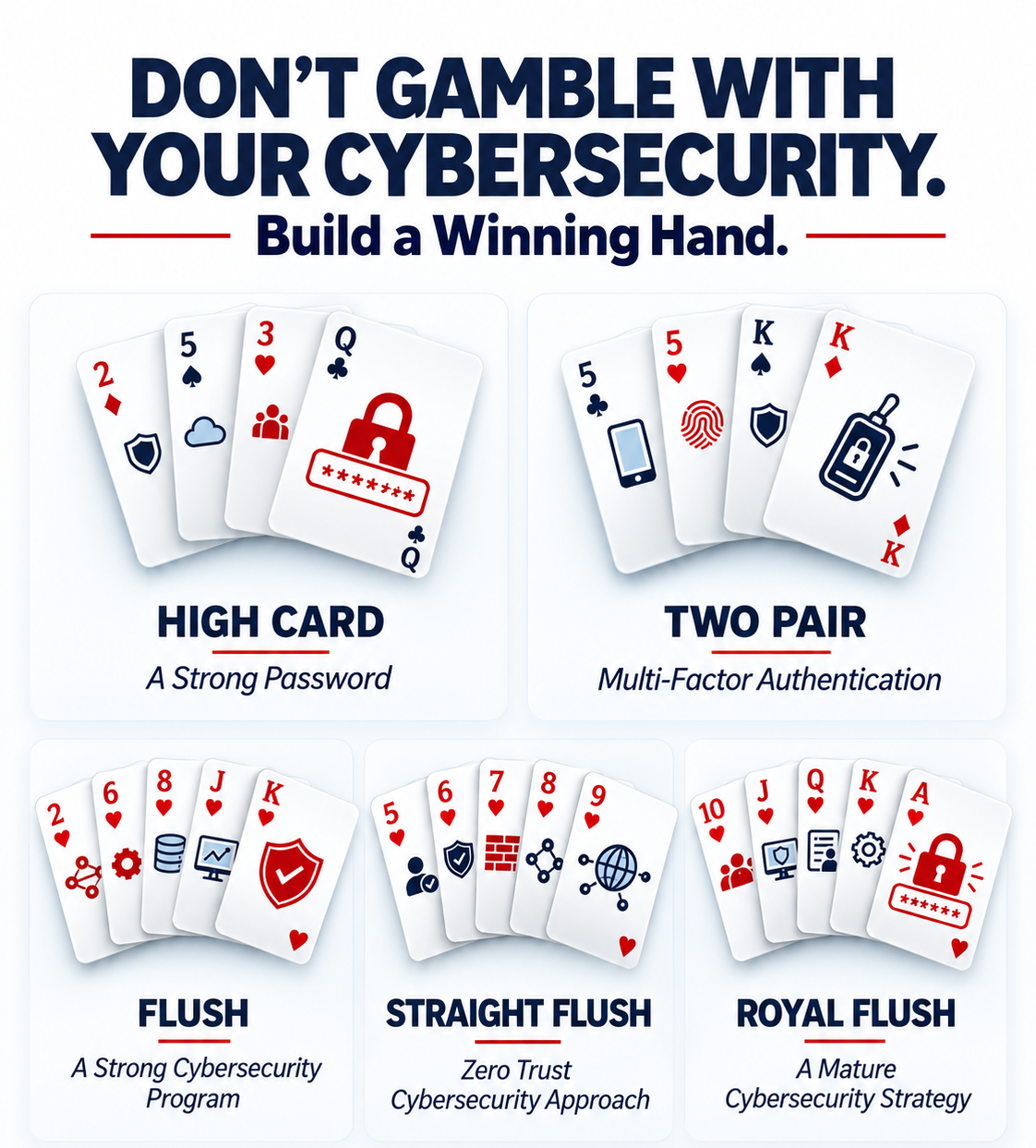
Here’s how common cybersecurity practices compare to different poker hands.
High Card: Strong Passwords
Every good cybersecurity strategy starts with the basics.
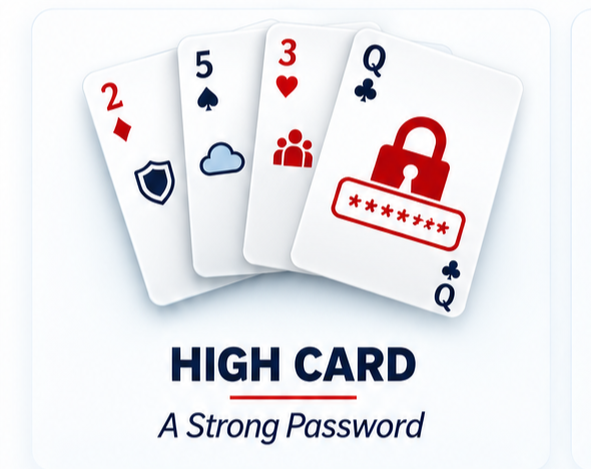
Strong passwords can help protect accounts from unauthorized access, especially when they are unique, difficult to guess, and not reused across multiple systems. But a password alone is like holding a high card in poker. It gives you some protection, but it may not be enough against more advanced cybersecurity threats.
Strong passwords are most effective when they are combined with additional security controls.
Pro Tip: And don’t use the same password for everything.
Two Pair: Multi-Factor Authentication

Multi-Factor Authentication, or MFA, adds another layer of security to the login process.
Instead of relying on only a username and password, MFA requires users to provide an additional form of verification, such as a code or phone call, an authentication app like DUO or Microsoft, facial recognition, or other approved methods. Even if a password is compromised, MFA can make it much harder for an attacker to gain access.
For organizations looking to improve cybersecurity quickly, implementing MFA is an important step toward stronger identity and access security.
Flush: Consistent Security Across All Systems
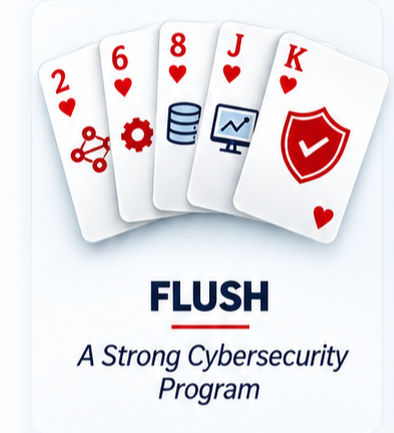
A strong cybersecurity program should protect more than just individual computers.
Your devices, applications, networks, accounts, and data should all follow consistent cybersecurity standards. When security policies and protections are applied across an organization, there are fewer gaps for cyber threats to exploit.
Consistency can include regular updates, access controls, endpoint protection, secure configurations, backups, and cybersecurity policies that apply across your environment.
Straight Flush: Zero Trust and Continuous Monitoring
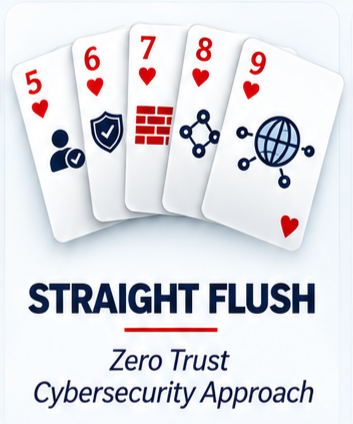
As organizations become more connected, cybersecurity cannot rely on automatically trusting users or devices simply because they are inside a network.
That is where a Zero Trust cybersecurity approach comes in.
The basic idea is simple: only trusted users and devices should be allowed access, and they should continue to be verified. Continuous monitoring adds another layer by watching systems, users, devices, and network activity for unusual or potentially malicious behavior.
Together, Zero Trust and continuous monitoring can help organizations identify cybersecurity threats sooner and respond more effectively.
Royal Flush: A Mature Cybersecurity Program
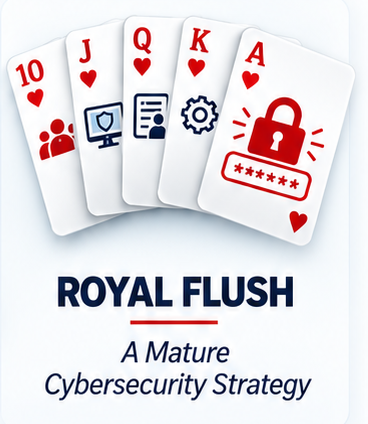
In poker, a Royal Flush is the strongest possible hand.
In cybersecurity, the equivalent is a mature cybersecurity program where multiple security practices work together.
A mature cybersecurity strategy may include:
Strong passwords and Multi-Factor Authentication
Identity and access management
Network and endpoint security
Regular software updates and patch management
Continuous security monitoring
Secure and reliable backups
Employee cybersecurity awareness training
Incident response and recovery planning
No single cybersecurity product can protect an organization from every threat.
Ultimately, the strongest cybersecurity programs use multiple layers of protection to reduce risk, strengthen resilience, and prepare organizations to respond when cybersecurity incidents occur.
What Does Your Cybersecurity Hand Look Like?